Journal
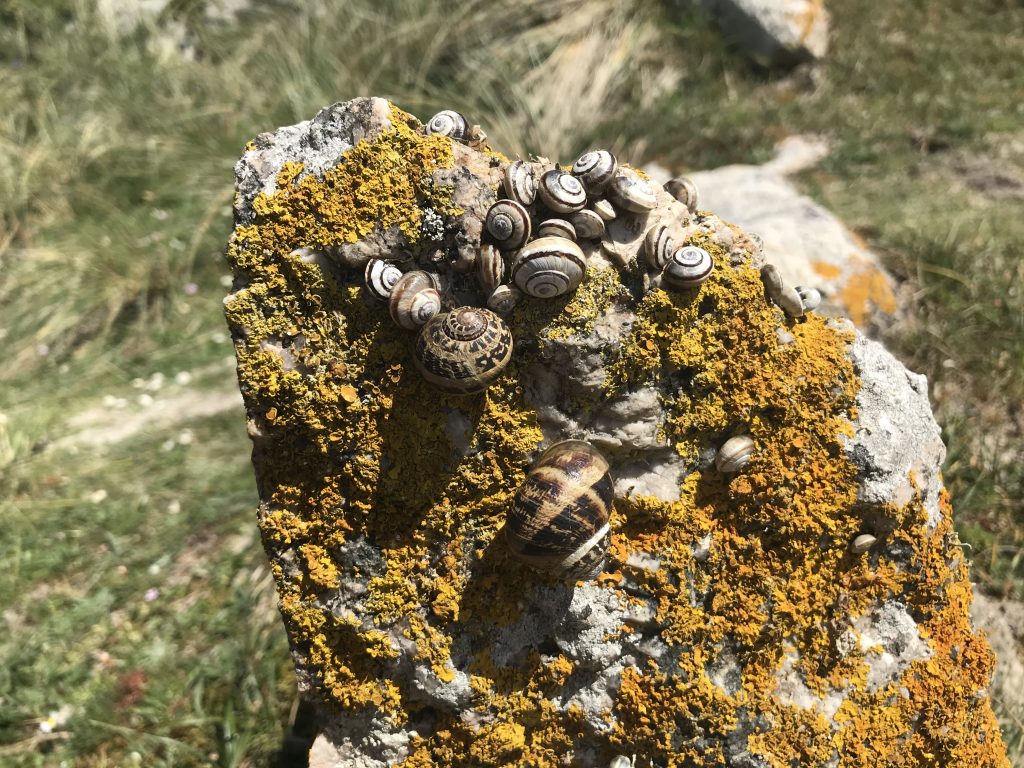
I’m in ‘lockdown’ at home in Cornwall. I feel very lucky to be living by the sea at this moment in time, when so much is in flux. Here, I’m aware of the steady cycles of the seasons, grateful for the daily gifts nature brings. Yesterday I held a globe of white blossom in my hand and marveled at its beauty, abundance and perfection. Today I found a secret gathering of snails on a lichened rock.
The Green Coat

Every day the sea offers changing colours, tides and movement, and sometimes stillness. Today there is a full moon (7th of May) in Scorpio. Just before a full moon, the sea seems to flatten. A strange calm comes upon it. There is a pause before new movement appears. On the day of the full moon the tide goes out further than usual, pulling back the sea back as far as possible to reveal a huge crescent of white sand in anticipation of new tides; the beginning of a new phase.
In spite of the disruption to people’s lives, all the worrying changes to laws, the implementing of surveillance and potential biological technologies, which pose a threat to our civil and human rights (under the guise of keeping us safe); I still feel a new, positive tide of change being brought to us all and our planet.

I have been thinking about my grandmother a lot. Being separated from friends and family has made me remember those who aren’t with us anymore in physical form. She was also ‘locked down’ on the Isle of Man during the Second World War, and I’ve been thinking how that must have felt for her.
My grandmother left Austria because she didn’t like what was happening politically before the war. During the ‘Anschluss’, Austria was pulled into alliance with Germany. There were those that wanted that to happen and those who did not. My grandmother did not. She lived in Hungary for a little while, working as a nanny, before moving to England to work for another family. Some time around then, she was interned on the Isle of Man for a year because the English government thought she might be a spy.
She did say to me once or twice that it was the happiest time of her life! The father of the family she had been working for was a civil servant, and it was he who managed to secure her release. She returned to work for the same family for a while before leaving for London, with the intention of training to be a nurse. The father of the family was also in London and his wife insisted my grandmother look after him. She changed her plans and became his housekeeper.
One night when bombs were falling, huddled under a table for shelter, they shared a few glasses of Sherry (or Benedictine, depending on who’s telling the story). That night my mother was conceived. Her father refused to believe she was his (until she was a teenager, when he proposed and my grandmother turned him down.)
When my mother was born (in 1943), my grandmother was unmarried and without work. Luckily somebody in the nursing home recommended her to a spinster she had heard of who was looking for a housekeeper. My grandmother and her baby were welcomed by Aunty Finch, as she became known.
Raising my mother, my grandmother and the eccentric Aunty Finch became the greatest of friends. It was my grandmother who laid out Aunty Finch’s body when she died. And having begun work as housekeeper in the big house in Hampstead, she inherited the house when Aunty Finch died.
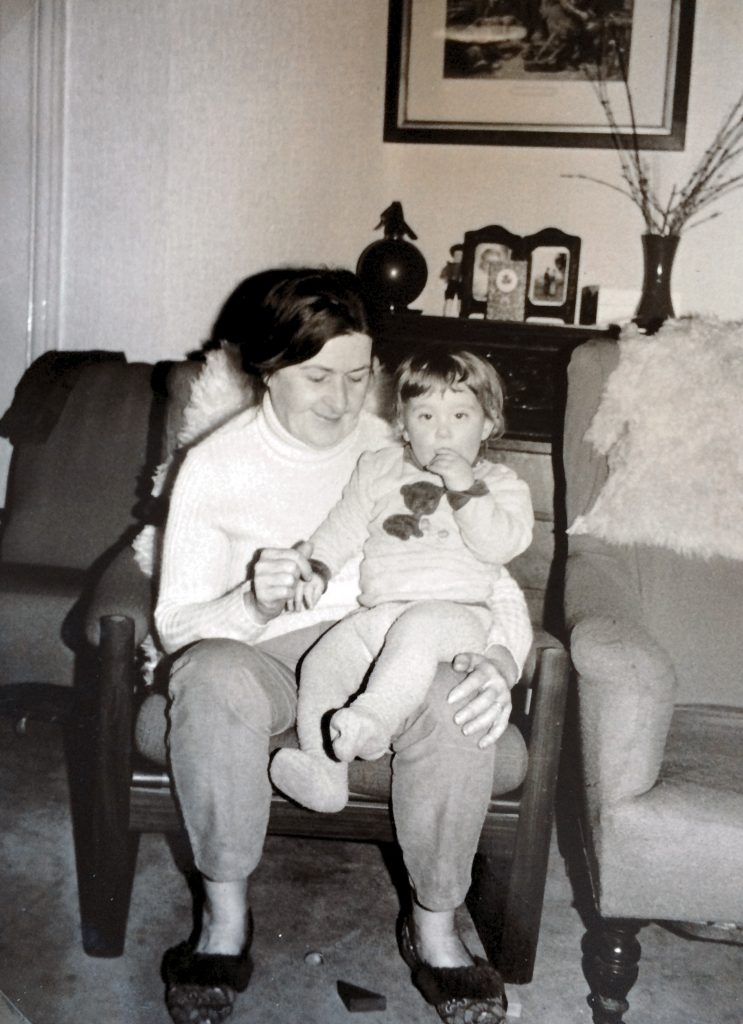
I wrote the following short story last year, inspired by my grandmother and Aunty Finch (who sadly I never got to meet). This is my granny in the photo, with a small me on her lap, in the same sitting room as the one in the story.
I watched a video of a little Italian girl embracing her grandparents this week, after not seeing them for two months (they usually see each other every week). The embraces seemed to last for an eternity. I’m hopeful we will all treasure each other, related or not, so much more once this enforced separation is over.
The Green Coat: A Short Story
The young woman with neat auburn hair and gently beautiful face lit a match and watched the flame of the candle blossom into light. She unlocked the door to the cellar and let the glow guide her down the steps. In the darkest room, filled with glinting black, she put the candleholder on the wooden table and began to lift the dull lumps of coal onto her shovel and into a brass bucket. She put the last two pieces of coal on top with her hands, brushed them on her apron and swept the loose hairs from her forehead with her forearm.
Back upstairs, having lit the fire in the sitting room, she prepared a late lunch of cold roast chicken pieces, potatoes and green beans. The young woman placed the meal on a tray and set it down on the side table near the hearth. A little way from the fire, she knelt down and touched the soft plump cheek of her baby, adjusted her crocheted hat, wrapped the blanket a little more tightly around her and slightly adjusted the angle of the Moses basket.
She rolled the metal carpet sweeper over the rugs and polished the dining room table in anticipation of the guests due for dinner the next day, before taking off her pinafore and hanging it inside the door of the cupboard under the stairs. She peered round the door of the sitting room to see the Lady sitting by the fire, chewing slowly on a piece of chicken, whilst leaning over the Moses basket and widening her eyes as if surprised, while the baby girl smiled and gurgled back.
The young lady put on a dull grey knitted wool coat that was a size too small. On her way out her finger traced the shape of a slightly raised circle of darning where a moth had made small feast of one of the collars. For a moment she felt defeated. Taking a breath, her resolve restored, she opened the large Edwardian door, with its freshly polished brass, to a suddenly new, unexpected and breathtaking world of pristine white snow outside.
Her boots squeaked on the deepening snow as she walked up the utterly quiet road towards Hampstead Heath. She looked up at the grey swirling sky for a second, letting large soft flakes land on her eyelashes, and briefly, tentatively, the tip of her warm tongue. She loved the snow – how the world could be changed in a few moments, as if under a beautiful spell.
She allowed herself to see the black winter trees etched against the sky, as if she herself were drawing them with her eyes. She took it all in, feeling her heart grow inside her chest, delighted by her warm breath appearing like smoke in front her.
She remembered herself as a little girl, huddled with five brothers, two sisters and her parents around the Christmas tree, singing Silent Night; mesmerised by the candlelight reflected on her favourite blue glass bauble.
On the High Street, a group of children, wearing shorts (whose pullovers needed darning) were throwing snowballs at each other, and shrieking, unable to contain the thrill of this sudden gift.
Men and women, faces covered by hats and scarves were making their way home from the underground. Some glanced at the children disapprovingly. Didn’t they know there was a war on?
The young woman joined the queue for food, recognizing faces in the long line stretching out of the shop. She nodded modestly but kept her own face low. She tore off tickets for butter, bacon, flour and sugar and waited as each in turn was wrapped in paper and handed to her. “Bloody Irish – go back where you belong. Bloody foreigners!” spat a woman behind her.
The young woman quickly filled in her trolley, feeling fear invade her belly and travel like electricity up through her body until it tasted metallic in her mouth. The bell rang loudly as she opened the door to leave, making her feel even more conspicuous, and she noticed her hands shaking as she tried to close it again, as quietly as possible.
The wonderment of the snow had left her a little now, and she still had a long walk back to the house. The sky was almost black, and the air began to feel icy. She pulled her coat, now damp from the snow, a little tighter around herself. She crossed the street into Flask Walk, which she often did, to look at the books and antiques in the windows.
Almost immediately she sensed something was different. There was a light coming from one of the shop windows and it was spilling out, creating a semi-circle of gold on the white snow outside. Her whole body was drawn to it and she moved closer, losing herself in curiosity.
This was not a shop that she had seen before and that was most strange because she was here at least once a week. The gold Victorian curlicue lettering had faded and in the darkness it was hard to make out any name at all. Flecks of gold paint glinted intermittently through swirls of snowflakes. Then, not just her eyes but her whole being, beheld the one item displayed in that shop window.
Glowing and shimmering gently in warm light, was the most beautiful object she had ever seen. It was a coat in soft emerald green and it seemed to sing to her from behind the glass. It seemed alive.
In the unlit street, she was embraced by the shop’s aura as she stepped forward, until her nose touched the cold glass of the window. She saw that the coat was made of what looked like woven moss, decorated with the most delicate scattering of dew-drop silver beads. The tiniest of wild flowers of gentian blue and white seemed to grow from the soft folds of velvet green.
It was the most breathtakingly beautiful thing she had ever seen. She noticed a lovely scent. She swore she could smell pine trees and the air itself smelt crisper and fresher. She wondered if it was coming from the shop or the coat itself. She longed for that coat with all of herself.
Suddenly it was too much for her. Tears sprang from her eyes and waves of sadness rushed through her body. She couldn’t control the shuddering in her chest. Her face was hot with tears as she turned away and began walking home.
She glanced back once more to gather up the vision of the luminous green coat before pulling her trolley through the bollards and heading, now somewhat wearily back up the High Street.
The street was deserted now. The snow was still falling and across the road she could she blackout fabric being pulled over windows like eyelids determined on sleep. She grew suddenly cold from the inside, and felt completely alone, a small figure under the darkest sky. She thought of her brothers fighting on behalf of the enemy in a field somewhere far away.
By the time she got back to the house her feet were wet, there were damp patches around the shoulders and chest of her cardigan, and her nose was tingling.
The next day was a flurry of activity. Another young woman called Flora who sometimes helped at busy times had been sent for, and the preparations started at six in the morning. Fires were to be lit early and kept going throughout the day. Potatoes were peeled, a pie was baked, a roast prepared and ingredients arranged on the sideboard ready for dessert and hors d’oeuvres.
The Lady remained in bed for the first half of the day, shouting instructions at them both from upstairs, and calling for them regularly to make sure they remembered this or that. The young lady didn’t mind, she knew she got nervous when her family visited, and she was grateful that her baby was safe and watched over by the Lady while she worked.
It was dark outside, and the bright snowflakes were falling like spring blossom outside the kitchen windows, but the young lady was too busy to pay them too much attention. Flora skipped efficiently around boiling pots, flour filling the air, crockery being stacked; her hands were always ready to help without having to be asked.
The Lady came downstairs in her finery, including layers of pearl and crystal necklaces, which she only wore on occasions such as this. She wobbled slightly on the final stair and the young lady swept towards her, taking her baby in the basket from her. “I’ll put her in my room,” offered the young woman.
“You really don’t have to, dear.” Reluctantly, the young woman put her baby daughter in the sitting room, just behind the door but near enough to the fire so she wouldn’t get cold.
The table was set and everything was ready by the time voices were heard outside. Edmund, the Lady’s older brother, was laughing loudly when the knocker sounded. Flora opened the door and immediately held her arms out to receive the outer garments of: Edmund, Harold (the Lady’s younger brother) and Harold’s wife, Cynthia. The guests shook snow from their clothes and handed coats and hats to an increasingly heavily laden Flora. The Lady appeared from the kitchen.
“Welcome! …Harold, Edmund, Cynthia.” The lady kissed them daintily on both cheeks. “How are you all? It’s been a very long time.”
Harold shifted his shoulders and smiled awkwardly, his body struggling with his feelings of guilt and family gossip.
“Fine except for this awful weather!” said Cynthia, frowning and shaking her head.
“I’m famished!” announced Edmund, talking over her.
“We can have supper immediately if you’d like,” replied the Lady
“Shan’t we have a drink first?” asked Cynthia. Her insistence on the etiquette of a drink before dinner an attempt to veil her desire for the soothing effects of alcohol.
“Let’s have something in the sitting room and then we’ll eat,” said Harold calmly, still holding his wife’s arm.
Edmund’s face reddened. His watery blue eyes shot a nasty glare at his younger brother.
The young lady stepped timidly into the room that contained the guests as well as her sleeping daughter. She tried hard not to look at the wicker basket holding her baby.
“Is there anything you need, Ida?” asked the young woman.
A sudden and uncomfortable silence filled the room.
“We’ll be eating shortly – thank you, Anna!” replied the Lady.
“She called you by your first name?!” Cynthia asked almost matter-of-factly, compared to the repugnant shock expressed by Edmund and Harold’s silence.
The Lady raised both eyebrows and slowly shook her head. She spoke slowly and deliberately.
“Must we really be concerned with silly formality when thousands of our young men are dying every day? This young woman has become a friend to me. She has been here when many others have not.”
She took a breath, feeling herself shake slightly and smoothed her silk dress.
“The world has changed. It does not serve us to cling to the past… ”
“Oh really Ida, there’s no way you could’ve married that man!” exploded Edmund. “Mother and Father could never have allowed it!”
The little girl lying in the Moses basket made a restricted sound and then began to cry very loudly. Anna burst out of the kitchen and found herself in the centre of the room. Frozen for a second, with all eyes on her, she suddenly felt hot and cold, and strangely light-headed. She felt as though she could pass out, and at the same time she could feel her heart beating all through her body, starting in her feet and moving to her fingertips. She grabbed her baby, holding her tightly to her chest, swaying slowly to calm her.
Looking around the room she saw the outrage on the guests’ faces, the confusion, the shock and the disgust. The young woman felt the familiar poison of shame fill her veins. There was something wrong with her. She was wrong, it told her. Still holding her daughter, she picked up the basket and left the room. Following her upstairs were fragments of Edmund’s voice: “…How could you disgrace yourself? …Our reputation…” And Cynthia’s: “…harbouring an unmarried mother…”
High up in the house, in her little room, she heard the large front door slam downstairs and knew that the evening was ruined. She’d ruined it by being there. She’d ruined it a year and half earlier by allowing herself to be seduced by the broken man whose family she had been looking after. She would pack in the morning she thought to herself.
She woke early and packed quickly. Downstairs in the hall, she carefully placed a handwritten notecard in an envelope by the clock on the mantelpiece (thanking the Lady for her help). She adjusted the baby’s blanket and opened the cupboard under the stairs to get her coat.
She was distracted by opening the door, and she didn’t see it at first; but looking up for her old coat, saw in its place, illuminated under the little bulb, a magnificent emerald green one. It was so new that it seemed to smell a little like freshly mown grass, and the threads sparkled and shone in the dim light. The young woman began to cry: this unexpected kindness on top of so many kindnesses.
“Do you like it?” asked the Lady, coming down the stairs in her dressing gown.
“I saw it in the village and thought it would suit you. That grey thing was looking terribly worn.” She continued, “…Are you going to try it on?”
The young woman took the coat from the hanger and slipped one arm silkily on, and then the other. It was as though it was made for her. It was warm and soft and she felt elegant. She somehow felt more herself than she ever had. She touched the velvety green lapel.
“I thought so!” clapped the Lady.
“What’s this?…” Her eyes indicated the suitcase.
“I hope you’re not thinking of leaving me. I couldn’t possibly manage this place without you and besides who would I talk to? You’re all I’ve got. It would be positively cruel!”
Looking at Ida, Anna didn’t know what to say, she was so full of different feelings.
Ida paused for a moment, seeing everything written on Anna’s face.
“I think I’d like the haddock this morning! Have you eaten? “
Anna didn’t know whether to laugh or cry, so she did a little of both; and then, still wearing her green coat, prepared two pieces of haddock with a little butter and brown toast for their breakfast.
Copyright: Rebecca Promitzer.